Back to portfolio

Enterprise SaaS · Ethics & Compliance · AI-assisted concept

Concept proposal at Mitratech · not implemented

Syntrio Action Center: Turning Incident Signals into Preventive Compliance Action

A concept proposal that brought incident oversight, organisational trends, active case work, and human-reviewed training and policy guidance into one compliance workspace.

  • Syntrio Action Center · enterprise desktop web application
  • Product Designer · concept and prototype contributor
  • Working users: compliance managers, incident managers, training administrators, and policy stakeholders
  • Scope: incident oversight, trends, recommendations, recent activity, and preventive-action framing

Only the Action Center dashboard is shown publicly. Detailed incident-management, training, policy, permissions, and administrative workflows remain internal and confidential.
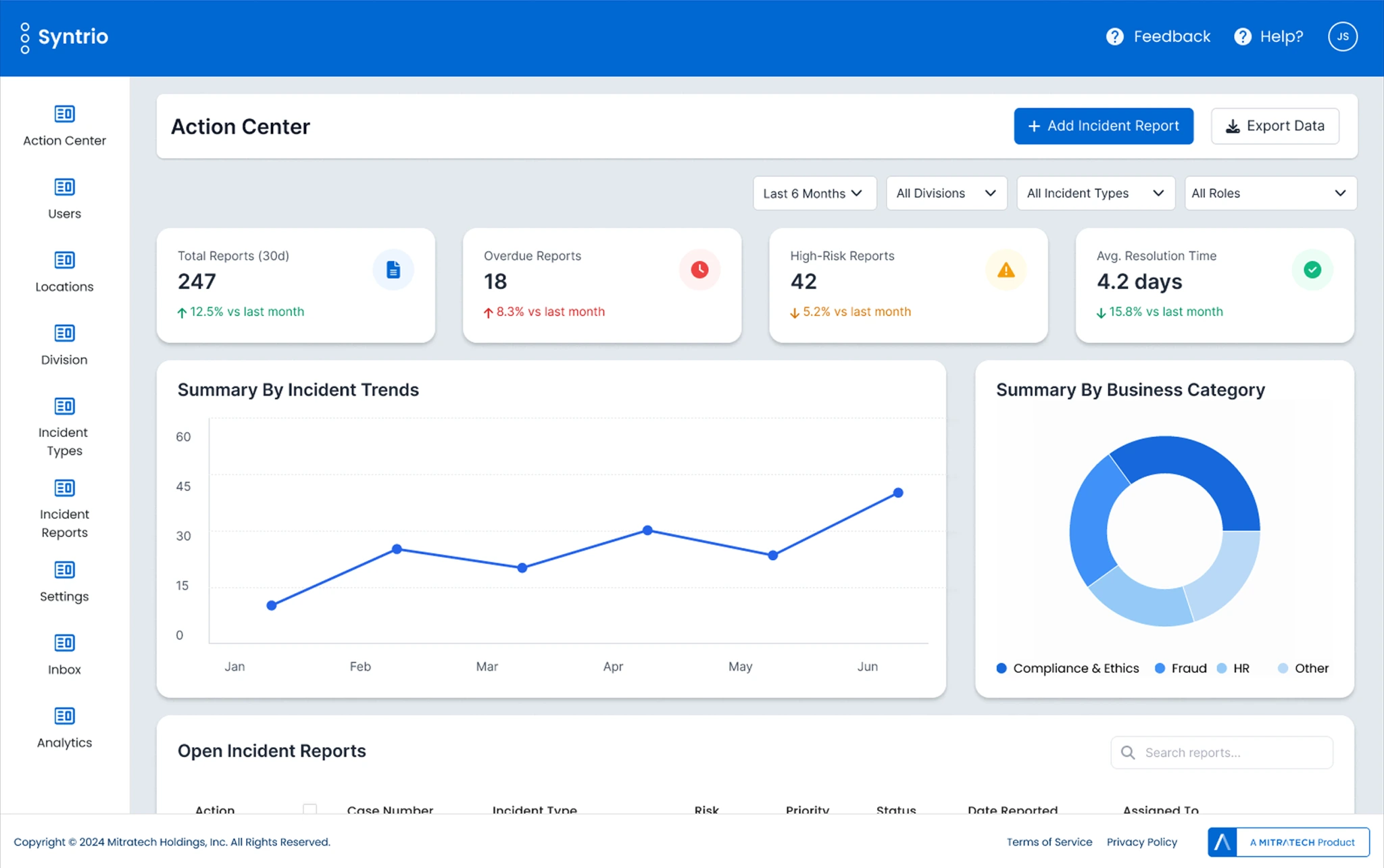
Syntrio Action Center concept with organisational filters, report metrics, incident trend chart, category chart, and incident queue
Original Action Center concept. Public imagery uses sanitised identities while preserving the historical interface structure and product styling.
01

Project at a glance

Exploring a connected starting point for compliance operations

Product
Syntrio Action Center
Company
Mitratech
Role
Product Designer · concept and prototype contributor
Primary user
Compliance or Ethics Programme Manager
Scope
Incident oversight, trends, recommendations, recent activity, and preventive-action concept
Public evidence
One high-fidelity desktop Action Center design shown through full views and crops
Status
Concept and prototype proposal; not implemented or released
Confidentiality
Related product workflows are discussed at system level but not shown

Evidence boundary

The historical evidence supports the dashboard concept and proposal. The business framing, working user model, responsible-AI principles, critique, and validation plan are retrospective product work created to explain how the concept could operate as a complete enterprise experience.

02

Product opportunity

Incident data showed what had happened—but not always what the organisation should do next

Compliance teams could capture and investigate workplace incidents, but the broader work of prevention could remain split across case management, reporting, employee training, and policy-management processes.

A compliance manager who noticed a recurring concern might need to export incident information, analyse patterns outside the product, identify the affected audience, locate relevant training, contact the appropriate policy owner, and document why the intervention was initiated.

The Action Center concept explored a more connected journey from detection to prevention: one workspace for current incident operations, organisational signals, and relevant preventive guidance.

Design challenge

How might we help compliance managers move from reactive incident monitoring to timely, evidence-based preventive action while protecting sensitive report data and keeping every recommendation under human control?
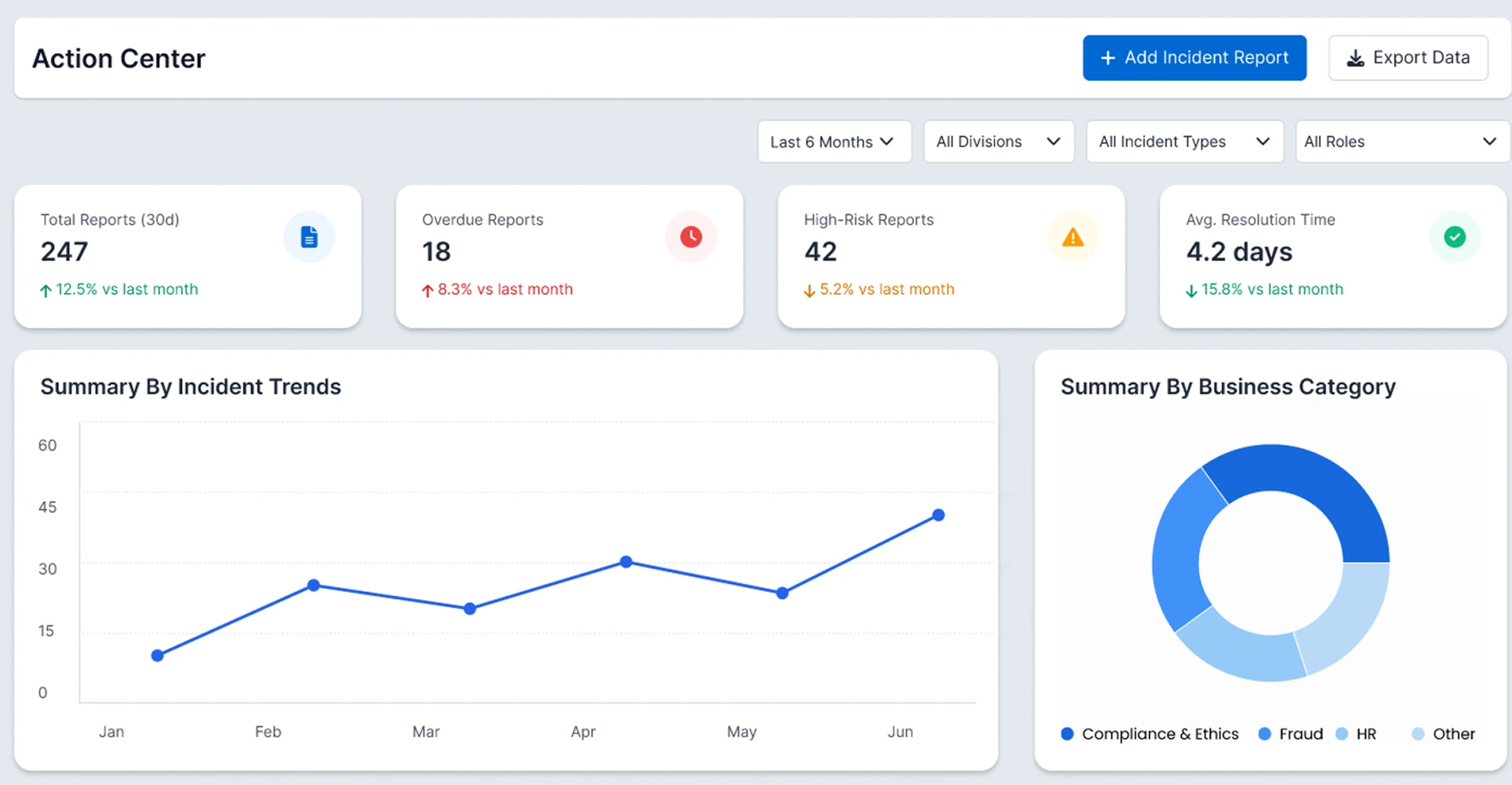
Action Center filters, report summary cards, incident trend chart, and incident category chart
From awareness to follow-through. The concept brought current work and broader patterns into the same starting point.

Fragmented workflows

Incident, training, and policy activities could require separate tools and manual handoffs.

Manual interpretation

Patterns could require exports and analysis outside the product before a response was coordinated.

Connected-platform opportunity

A unified feedback loop could connect detected concerns with relevant training and policy action.

03

Working user model

One compliance signal, several professional responsibilities

These are responsibility-based role profiles developed for the concept. They are not presented as personas derived from completed interviews.

Compliance Programme Manager

Reviews the backlog, identifies patterns, and coordinates authorised preventive action.

Case Owner or Investigator

Finds assigned work, understands urgency and deadlines, and continues case follow-up.

Training Administrator

Reviews approved learning content, confirms the audience, and coordinates assignment.

Policy Owner, Legal, or HR

Reviews whether existing guidance should be clarified, updated, or communicated differently.

Compliance Leader

Reviews permitted trends, unresolved risk, action ownership, and programme response.

Primary job to be done

“When I review incident activity, I need to identify what requires immediate attention and whether broader patterns justify preventive action, so I can coordinate the right response without exporting sensitive data or switching between disconnected systems.”
04

Product model

Connect the organisational signal to a responsible human decision

The Action Center was most valuable when it connected what the system observed to the next authorised decision—not when it simply displayed more metrics.

Incident reports Permitted case and programme data
Aggregated signals Patterns within an authorised scope
Trend or exception Context requiring review
Suggested guidance Approved training or policy resource
Human review Accept, modify, dismiss, or escalate
Preventive action Owner, scope, and due date
Audit and monitoring Track decision, status, and future signals

Dashboard anatomy

One workspace organised into four information layers

Each crop below comes from the same original Action Center dashboard—not a separate product screen.

1

Overview

Summary cards provided a quick view of volume, overdue work, high-risk cases, and resolution time.

  • Current workload
  • Attention signals
  • Operational measures
2

Organisational context

Filters and charts helped users examine changes by period, division, and incident category.

  • Time period
  • Scope filters
  • Trend and category views
3

Operational follow-up

The incident queue linked summary information to case number, risk, priority, status, and owner.

  • Active records
  • Ownership
  • Case actions
4

Preventive guidance

Training, policy, and activity panels connected case signals to broader programme response.

  • Suggested training
  • Potential policy reviews
  • Recent organisational activity
05

Design decisions

Four decisions shaped the product proposition

01

Connected compliance

Bring reactive and preventive work into one starting point

Incident management explained what had been reported. Training and policy management supported broader prevention. The concept connected both sides so users could move from awareness to the appropriate next decision.

Product question
How can a signal from current case work support an organisation-level response?
Design response
Combine current workload, historical context, ownership, and preventive guidance in one Action Center.
Trade-off
A broad dashboard risks overload, so immediate operational work and supporting analysis need a clear hierarchy.
Full Syntrio Action Center concept showing the connected compliance workspace
The original dashboard establishes the overall product proposition.
02

Data semantics

Separate current operational snapshots from historical reporting

The original screen combines a six-month filter, a 30-day report count, month-over-month changes, current overdue incidents, current high-risk incidents, and average resolution time.

Period-based reporting
New reports, resolved cases, trends, and resolution-time measures for a defined date range.
Current-state snapshots
Active overdue, high-risk, unassigned, or review-needed incidents as of a stated time.
Why it matters
Changing a reporting period should never hide an older unresolved incident from the active backlog.
What I would refine before validation

Show exact date ranges, last-updated time, metric definitions, comparison basis, and a direct drill-down to the matching records.

Action Center scope controls, metrics, trend chart, and category chart
Different measures need explicit time and scope rules to remain trustworthy.
03

Operational clarity

Keep risk, priority, status, and ownership distinct

These fields answer different questions during triage. Combining them into one generic severity indicator would weaken accountability and make sorting less meaningful.

  • Risk: potential significance or exposure
  • Priority: operational urgency
  • Status: current workflow stage
  • Owner: person responsible for the next authorised action

These definitions are the conceptual model used to critique the design; the original product rules and permission model were not recovered.
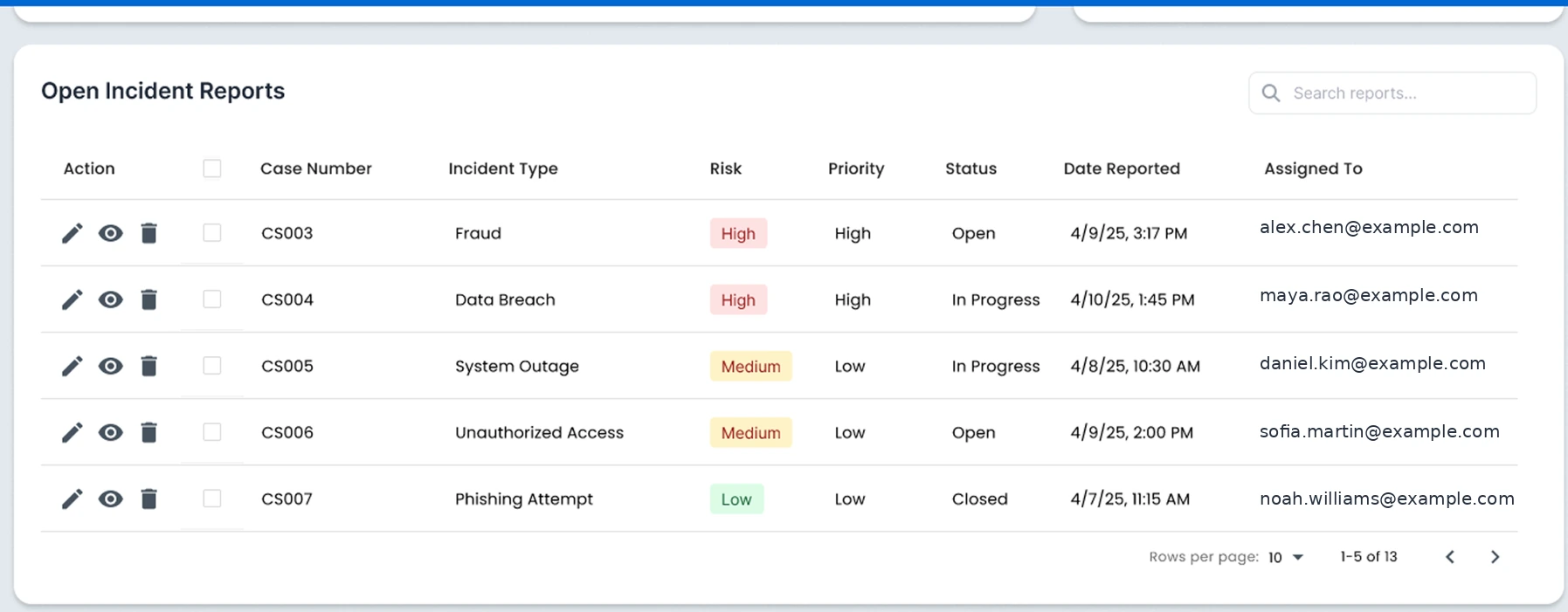
Syntrio Action Center incident queue showing risk, priority, status, date, and assigned owner
The queue is the bridge between summary information and individual case work.
04

Human-reviewed guidance

Keep recommendations explainable, advisory, and under human control

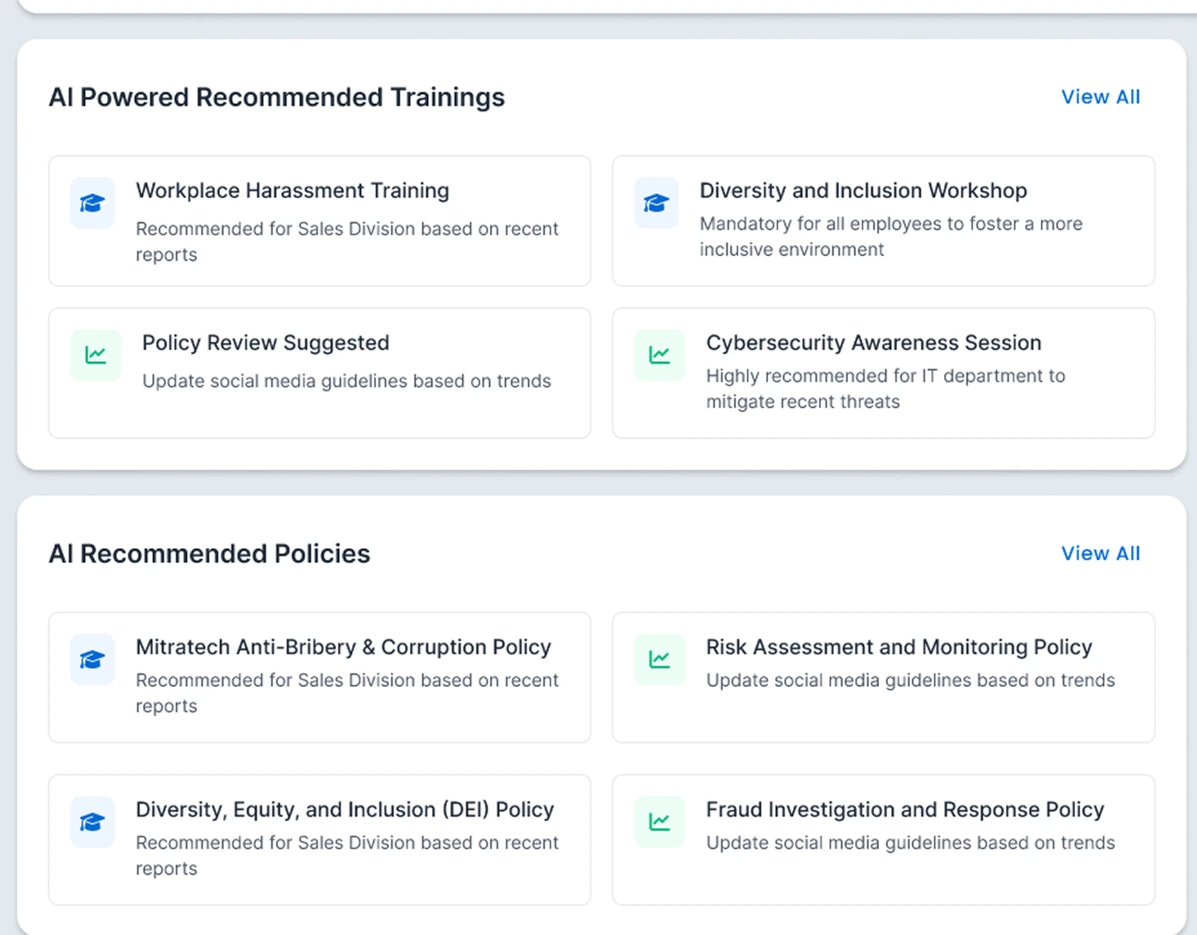
The dashboard included AI-labelled training and policy suggestions, but it did not visibly explain their basis, source, time period, affected audience, or available user action.
Recommendation anatomy
Resource, affected scope, “Why suggested,” aggregate signal, data period, owner, version, and review state.
User controls
Review evidence, accept, modify, dismiss, mark as addressed, assign an owner, and give relevance feedback.
Critical guardrail
A suggestion must not determine fault, change case risk automatically, close an incident, assign mandatory training, or update a policy without authorised review.
Syntrio Action Center training and policy recommendation panels
The original concept introduced guidance; the next requirement was to make it understandable and actionable.
06

Responsible product model

AI could surface relevance—but responsibility remained with people

The original screen used an AI label, but the proposal did not progress far enough to establish a production AI architecture.

A credible first version would begin with transparent mappings between approved incident categories and approved learning or policy content. AI could then be evaluated as an extension for ranking, pattern summarisation, semantic retrieval, and plain-language explanation.

The choice to introduce AI should follow a demonstrated relevance problem—not the presence of an “AI-powered” heading.
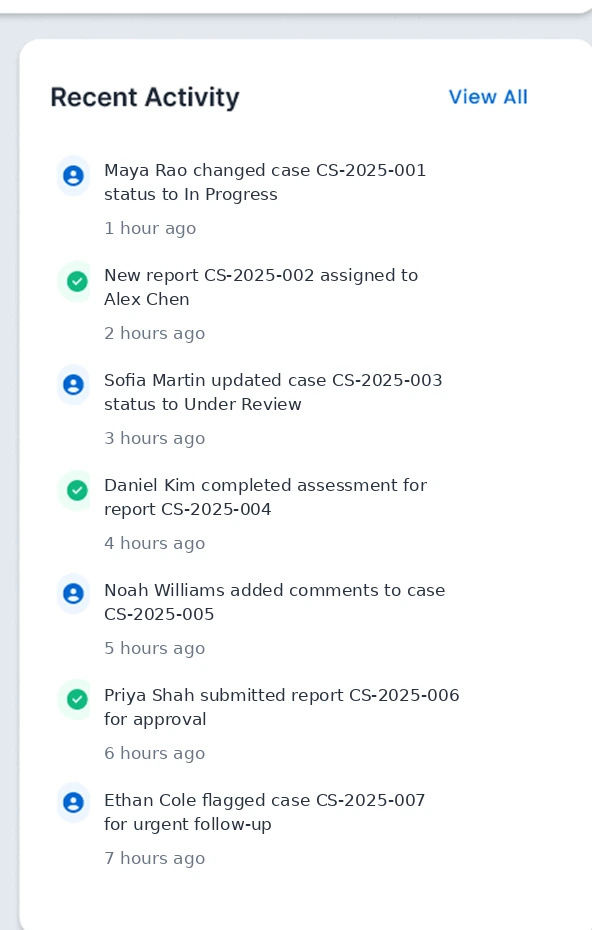
Syntrio Action Center recent activity panel with synthetic user names and case events
Recent activity is useful context, but it should not be mistaken for a complete audit history.
Permitted aggregate signal
Approved content source
Why suggested
Human review
Accept, modify, or dismiss
Owner and audit record

Explainability

Show why a suggestion appeared, the scope it relates to, and which approved source it uses.

Privacy

Prefer aggregates, minimise data, protect reporter identity, and suppress signals that could expose individuals.

Human control

No training, policy, risk, or case decision should be executed automatically.

Permissions

Cards, charts, search, recommendations, exports, and drill-downs must share one access boundary.

Auditability

Record the signal, recommendation version, reviewer, decision, modification, owner, and resulting action.

07

Critical design review

What I would refine before putting the concept in front of users

P0 · Credibility and safety

Resolve contradictions and consequential actions

  • Keep closed cases out of the default “Open Incident Reports” queue, or rename the view.
  • Separate current snapshots from historical reporting and define every comparison period.
  • Add due date or days overdue so the overdue summary is actionable.
  • Move delete or archive into a permission-aware menu with confirmation, reason capture, and audit history.
  • Explain recommendation basis, source, scope, and human-review responsibility.
P1 · Comprehension and efficiency

Make daily work easier to interpret

  • Clarify what “All Roles” filters and ensure filters never change permissions.
  • Reveal bulk actions only after selection and make the selection scope explicit.
  • Correct the page-size and result-range mismatch.
  • Add explicit values and an accessible data view to category analysis.
  • Sort activity newest first and use one case-identifier format.
  • Use neutral treatment for increased report volume; more reports are not automatically positive.
  • Give navigation sections distinct icons and clearer grouping.

Enterprise states

The dashboard also needed to explain when information was absent, stale, restricted, or incomplete

Loading and refresh

Preserve page structure, identify the areas still loading, and show last successful update.

No active work

Distinguish a healthy empty queue from no matching results or unavailable data.

Restricted access

Explain the available next step without revealing that a restricted record exists.

Partial failure

Isolate failed widgets, retain clearly labelled safe data where appropriate, and provide Retry.

08

Retrospective validation plan

Test whether users can move from signal to responsible action

Representative tasks

Observe behaviour before asking for opinions

  • Identify the most urgent overdue incident and its owner
  • Explain risk, priority, status, and the selected reporting period
  • Change organisational scope without assuming access has changed
  • Review why training or a policy resource was suggested
  • Decide whether to accept, modify, dismiss, or escalate the suggestion
  • Find the actor, rationale, owner, and audit record for the decision

Prioritisation

Correct record selected, urgent items missed, assistance required, and time to locate relevant work.

Data comprehension

Correct period interpretation, risk versus priority understanding, and filter-scope comprehension.

Recommendation comprehension

Can explain why it appeared, identify the audience, recognise human responsibility, and choose a next action.

Accessible operation

Keyboard completion, visible focus, table and chart comprehension, meaning beyond colour, and assistive-technology findings.

This validation plan was not executed during the original concept phase. Numeric targets would be set only after establishing a baseline with representative users.

09

Design outcome and boundaries

A strategic product concept—not a shipped AI system

What existed

  • Syntrio Action Center concept
  • High-fidelity desktop dashboard
  • Incident summary and trend views
  • Incident queue and recent activity
  • Training and policy recommendation concept
  • Internal prototype and proposal

What did not occur

  • Product implementation or production release
  • Live AI functionality
  • Verified product integrations
  • Formal user research or usability testing
  • Pilot, adoption, or business measurement
  • AI-performance evaluation

What the project demonstrates

  • Strategic product-opportunity framing
  • Enterprise dashboard and information hierarchy
  • Reactive-to-preventive compliance thinking
  • Human-in-the-loop AI principles
  • Privacy, permissions, and audit awareness
  • Critical evaluation and validation planning

Public presentation boundary

The product image shown throughout this case study is the same original Action Center dashboard at different scroll positions and crops. Related internal workflows are intentionally discussed without showing confidential product screens or recreating them as if they were historical deliverables.

10

Reflection

What this concept reinforced for me

Insight must lead to action

A dashboard creates value when a user can understand the signal, open the underlying work, and take an authorised next step.

Time models need explicit rules

Current backlog, overdue work, historical submissions, and resolved-case measures should never be mixed silently.

AI needs evidence and boundaries

The recommendation matters less than whether the user understands why it appeared and what responsibility remains with them.

Privacy shapes the experience

Access, aggregation, anonymity, audit history, and accountability are core interaction requirements in ethics and compliance products.

Strongest next step

Validate the product model before investing in recommendation technology

  • Confirm the compliance manager’s real prioritisation workflow
  • Define the safe data and permission model
  • Establish a transparent rules-based relevance baseline
  • Test whether AI improves relevance, explanation, or retrieval beyond that baseline