Healthcare · Clinical workflow design

Designing a clinician-controlled oncology workflow

A zero-to-one engagement connecting professional onboarding, patient registration, case management, treatment planning, chemotherapy scheduling, treatment sessions, and follow-up in one longitudinal platform. Delivered through Techtrail Consultancy Services. The end client, geography, release scale, and all patient and professional data remain confidential.

  • Oncology patient, case, treatment-planning, chemotherapy, and follow-up platform
  • Product Designer & React Front-end Contributor
  • Approximately six months · confidential pilot and client release
  • Product stakeholders, specialist oncologists, engineers, QA, and clinical users
  • Owned product workflows, information architecture, navigation, forms, interaction states, UI, prototyping, and React contribution
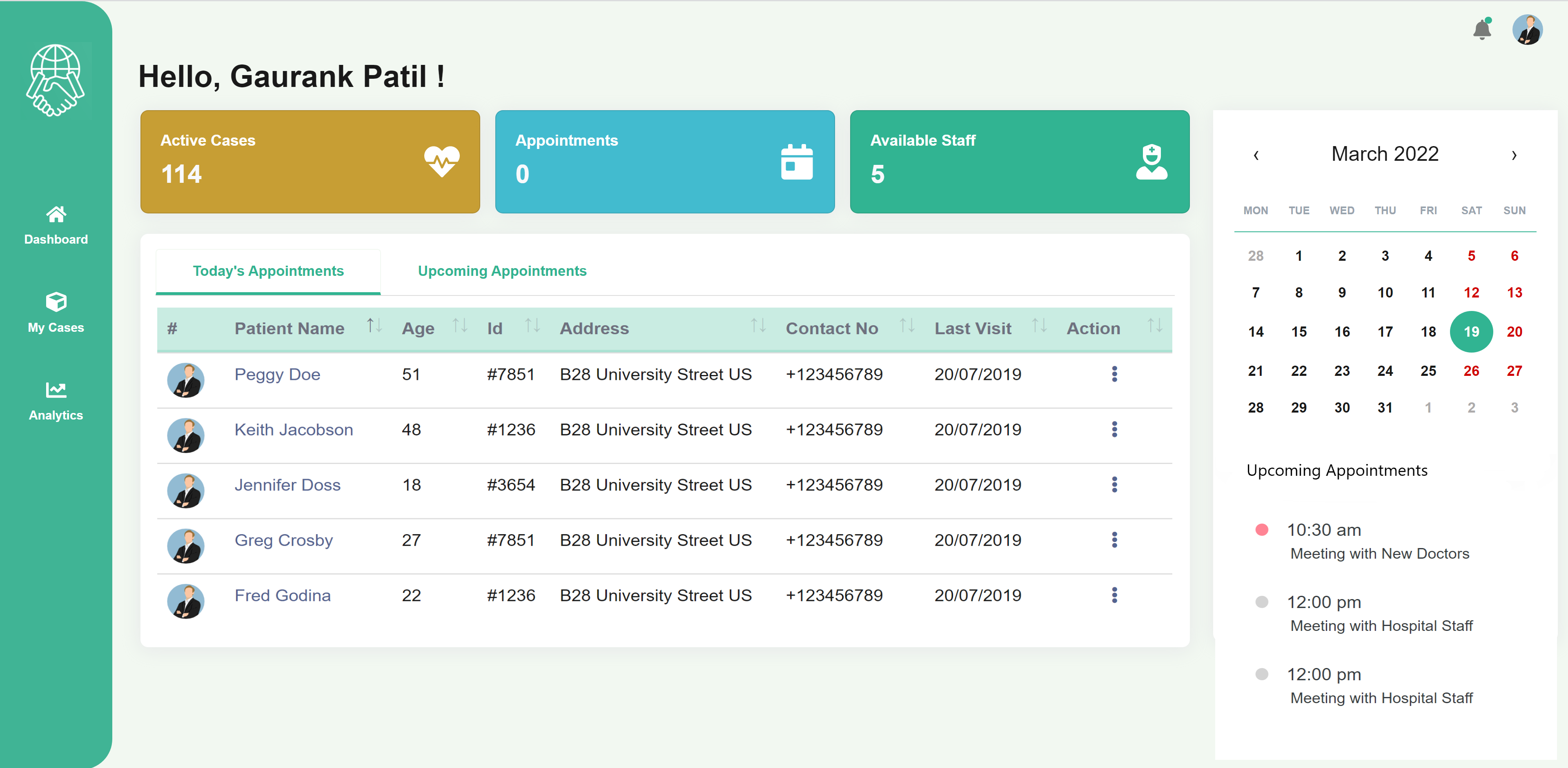
Oncology operational dashboard showing active cases, appointments, staff availability, and the daily patient queue
02

Context and challenge

Connecting clinical decisions, operational coordination, and longitudinal care

The client needed more than a patient-record interface. The product had to connect patient administration, case ownership, treatment planning, chemotherapy delivery, and follow-up across several professional roles. The existing problem space was fragmented across clinical and administrative activities. Designing each stage as an isolated feature would make teams repeatedly relocate the patient, reconstruct context, and reconcile treatment information across separate parts of the workflow.

The platform also generated medicine suggestions from predefined clinical rules reviewed by specialist oncologists. The system could support professional judgment, but the treating oncologist needed to remain visibly responsible for modifying and confirming the final treatment plan.

Design challenge

How might we connect patient administration, oncology case management, treatment planning, chemotherapy delivery, and follow-up in one coherent workflow while keeping clinicians visibly in control?

Oncology operational dashboard image pending final replacement
Operational starting point. The final image will show active cases, appointments, staff availability, and the daily workload using synthetic data.
03

Clinical inputs and product synthesis

Translated team-led clinical discovery into one coherent product model

Research and clinical discovery were led by the wider team. I did not personally conduct the interviews or formal usability studies. My responsibility was to interpret the documented inputs, specialist review, and product requirements and translate them into workflows, information architecture, forms, states, and interaction behaviour.

Specialist oncologists validated terminology, treatment rules, regimen logic, and dosage-related requirements. I used that input to determine how information should be structured, where plan-level and session-level data needed to separate, and where clinician authority needed to remain explicit.

Clinical input to design decision

An anonymised synthesis of the evidence that shaped the product

These are consolidated product inputs, not direct participant quotations.

Clinical input

Care continued across multiple stages and roles

Patient, diagnosis, treatment, and follow-up context could not fragment when ownership or task changed.

Product decision

Create one persistent case workspace across the longitudinal journey.

Clinical input

A treatment plan and a treatment sitting were not the same record

Protocol intent, cycle schedule, session activity, delays, and follow-up required related but distinct structures.

Product decision

Separate plan-level, cycle-level, sitting-level, and follow-up information.

Clinical input

Rule-based suggestions could not replace professional judgment

Generated medicines needed specialist-approved logic and an explicit path for clinician modification.

Product decision

Keep generated suggestions editable and the final plan clinician-controlled.

Multi-role system

Shared patient context, different workflow responsibilities

The available materials support these workflow responsibilities; they do not fully document every role-by-role permission rule.

Oncologists

Reviewed clinical context, created or modified treatment plans, and retained responsibility for the final treatment decision.

Nurses and clinical support

Supported treatment-session activity, observations, documentation, and follow-up continuity.

Medical administrators

Supported patient registration, appointments, records, and operational coordination.

Case coordinators and hospital staff

Supported case continuity, scheduling, institutional association, and transfer-related work.

End-to-end workflow

One connected journey across clinical and administrative work

  1. Professional onboarding
  2. Operational dashboard
  3. Patient registration
  4. Case creation
  5. Initial assessment
  6. Treatment plan
  7. Cycle scheduling
  8. Chemotherapy sitting
  9. Follow-up
  10. Transfer or archive

Case views—not a mandatory sequence

Supporting different states of ownership and review

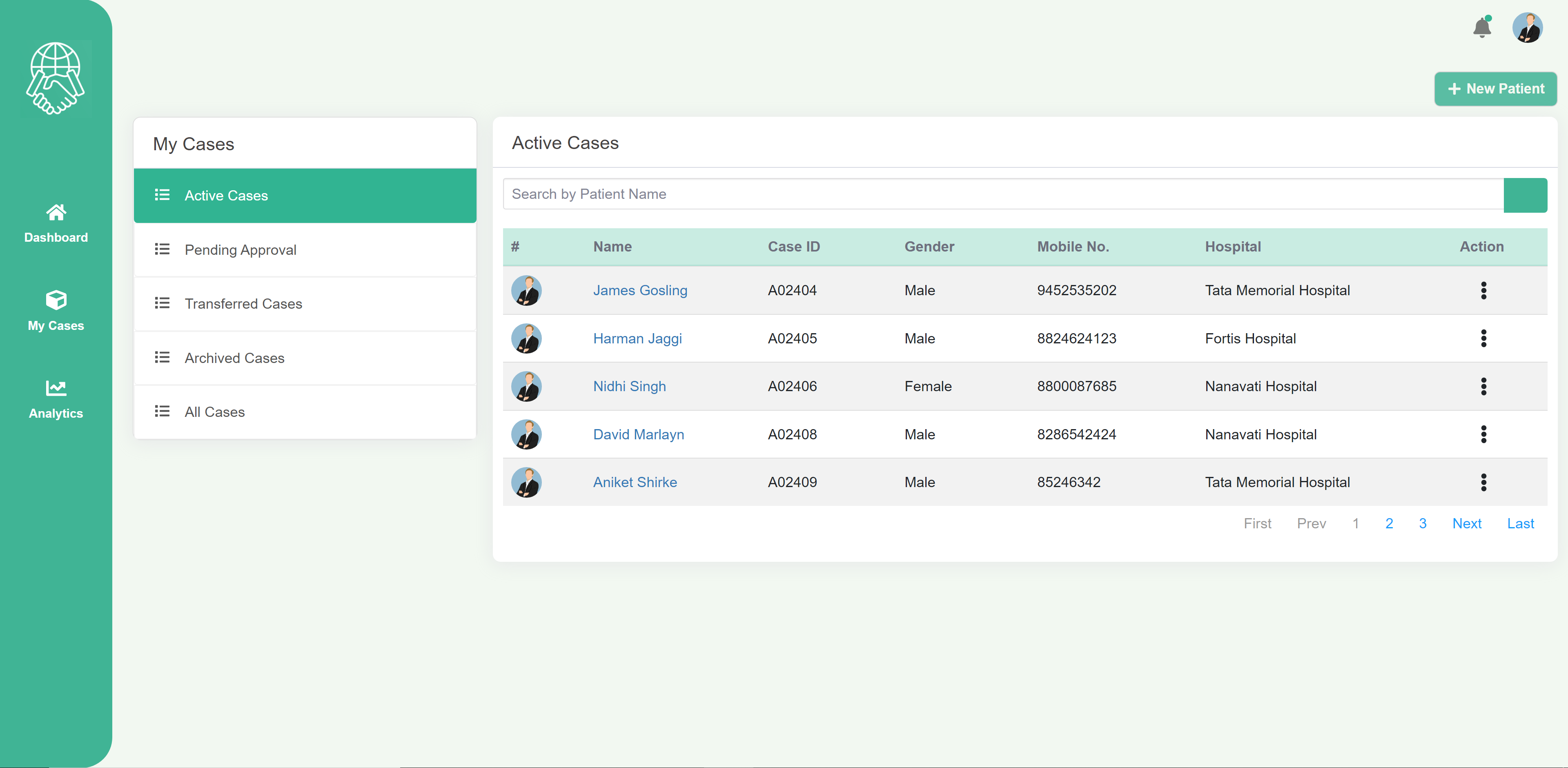
Active, pending approval, transferred, and archived were distinct case views or states. “All cases” was a consolidated view, not another lifecycle step.

Oncology case-listing image pending final replacement
04

Design decisions

Three decisions shaped the clinical workflow

01

Longitudinal case model

Organise the product around one persistent patient case

Problem
The patient journey crossed registration, assessment, treatment planning, chemotherapy sessions, follow-up, and possible transfer.
Design response
Create one case workspace with focused areas for Case Summary, Profile, Initial Assessment, Treatment Plan, Follow-up Appointment, and Chemotherapy Sitting.
Why it mattered
Essential patient and treatment context remained available while the user moved between stages and responsibilities.
  • One case identity across the treatment journey
  • Persistent patient and treatment context
  • Separate views for ownership, review, transfer, and archive
02

Clinical workflow structure

Separate treatment planning from chemotherapy execution

Problem
Treatment intent, regimen, cycle planning, consent, individual sittings, delays, dosage information, supportive treatments, and follow-up could not live in one undifferentiated form.
Design response
Separate protocol-level planning from cycle and sitting-level documentation, while retaining a relationship to follow-up.
Why it mattered
The care team could preserve a coherent treatment plan and maintain the history of each treatment event and schedule change.
1Planned cycle date
2Record delay and reason
3Review revised date and downstream schedule
4Save the updated sitting to case history

This flow describes the supported scheduling logic without claiming that every date was recalculated automatically.
03

Human-in-the-loop decision support

Keep rule-based suggestions under clinician control

Problem
Automatically populated medicine suggestions could improve consistency, but they could not be presented as an unquestionable final treatment decision.
Design response
Place rule-based suggestions inside the clinician’s treatment workflow and allow the oncologist to modify them before the plan was confirmed.
Why it mattered
The product retained the benefit of predefined clinical rules while keeping professional authority explicit.
Structured clinical inputs
Predefined clinical rules
System-generated suggestion
Clinician reviews and modifies
Clinician-confirmed plan

Clinical boundary: Specialist oncologists validated the rule logic and terminology; the treating oncologist retained responsibility for the final treatment decision.

05

Cross-functional collaboration

Balancing clinical consistency, usability, and professional authority

Design trade-off

Use predefined rules without presenting them as the final clinical answer

The product needed to make established treatment logic available within the workflow without obscuring who owned the final decision. Specialist oncologists validated the clinical rules and terminology. I translated that input into an editable suggestion flow, while product and engineering shaped scope, data behaviour, and implementation feasibility.

The resulting model preserved consistency and speed while keeping the treating oncologist visibly responsible for reviewing, modifying, and confirming the plan.

Clinical specialists
Validated terminology, regimen logic, dosage-related requirements, and the predefined treatment rules.
My design role
Structured the workflow, information hierarchy, forms, states, and clinician-modification path.
Product and engineering
Defined product scope, backend behaviour, technical feasibility, integration, QA, and deployment.
06

Design to delivery

From product architecture to a confidential React client release

As the designer, I defined the product workflows, information architecture, navigation, forms, interaction states, and visual design. I also contributed to the ReactJS front end by translating approved page structures, navigation, forms, validation states, and interaction behaviour into the working product.

The available material does not preserve exact module-by-module code ownership, so I do not claim that I independently built the full released application. Backend services, integration, QA, deployment, and the final client environment were owned by the wider team.

The product progressed through a confidential pilot and client release involving real clinical and administrative users. Release scale, client acceptance details, usage data, and clinical or business outcomes remain confidential or unavailable.

  1. Clinical inputsTeam-led discovery and specialist validation
  2. Product modelWorkflows, IA, roles, states, and forms
  3. High-fidelity designConnected end-to-end experience
  4. React contributionPage structures, forms, and interactions
  5. Clinical reviewTerminology and rule validation
  6. Confidential pilotReal clinical and administrative users
  7. Client releaseScale and outcome details remain confidential